Head lice are tiny, wingless, parasitic insects that live in human hair. They are a common problem and highly contagious. They can also be hard to get rid of. The eggs are known as nits.
Head lice are not a health hazard, a sign of poor hygiene, or a cause of disease. They are common among preschool and elementary school-age children and can spread to the rest of the household.
Adult head lice are about one-eighth of an inch long, the size of a sesame seed, and they live
A louse injects saliva into the host while feeding to prevent blood from clotting. This can result in an allergic, itching sensation for the host. Scratching the irritated skin can lead to a secondary bacterial infection. Apart from this, head lice do not transmit disease, and they are not dangerous.
Head lice or nits are often found near the neckline at the back of the head and behind the ears. Less commonly, they may appear on the eyelashes or eyebrows.
Some
Fast facts on head lice
- Head lice are tiny insects that live on the scalp, usually on children aged 10 years and under.
- They can move easily between hairs, at a rate of 9 inches a minute, but they cannot fly or jump.
- The lice need human blood to survive, and they starve within 2 days if they are removed from their host.
- Head lice are usually caught directly from another person through direct head-to-head contact. Pets do not play a role.
- Treatment involves over-the-counter (OTC) or prescription medication, but resistance to these treatments is growing.

Itching is the most common symptom of an infestation.
This is due to an allergic reaction to louse saliva. Some people are extremely sensitive to louse bites and have severe itching. Others are not allergic to the saliva, or they build up a tolerance and have little or no itching, even with repeated infestations.
Some people do not experience itching for the first 2 to 6 weeks of an infestation, as it can take this long to become sensitized.
As a result, the infestation may remain unnoticed.
Other symptoms
- tickling or a sensation of something moving in the hair
- irritability and difficulty sleeping
- sores on the head from scratching
- swollen lymph nodes, or glands
- pink eye
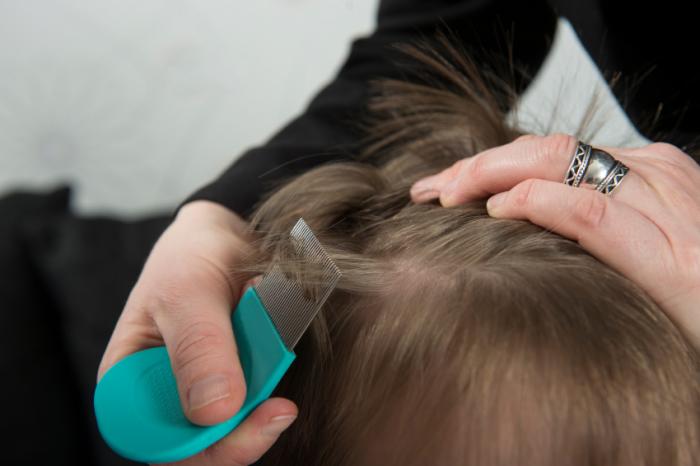
A fine-toothed comb can be used to help detect lice.
Before receiving any prescribed medications, there are steps that can be taken to treat a head lice infestation.
Wet-combing
Combing wet hair with a fine-toothed nit comb may remove lice and some nits. Research is inconclusive on the effectiveness of this method.
As well as the hair being wet, something should be used to lubricate the hair, such as a hair conditioner.
Comb the entire head from the scalp to the end of the hair at least twice during a session. The process should be repeated every 3 to 4 days for at least 2 weeks after no more lice are found.
Essential oils
Small clinical studies have suggested that some natural plant oils may have a toxic effect on lice and eggs. These products include:
- tea tree oil
- anise oil
- ylang-ylang oil
- nerolidol, a chemical compound found in many plant oils
- eucalyptus oil
- lavender oil
In one study, a spray containing a combination of coconut and anise was found to be significantly more effective at clearing head lice than a permethrin lotion.
One benefit of coconut oil and anise is that the effects are physical rather than neurological, so the lice are highly unlikely to develop a resistance. The treatment dries out the waxy outer shell of the lice, causing fatal dehydration.
The United States Food and Drug Administration (FDA) has not confirmed the safety and effectiveness of any essential oils for head lice treatment.
Should my child stay off school?
A child should not stay home because of lice. Some schools have had “no-nit” policies under which a child was not allowed to return to school until all nits were removed. The American Academy of Pediatrics and the National Association of School Nurses discourage no-nit policies.
However, children should keep their hat on a separate hook from other children at school, and they should not share combs, brushes, or headgear, unless it is protective head gear, such as a cycle helmet, where they would otherwise have to go without.
What about my child’s clothes?
Hats, bedding, and so on do not need to be thrown away if there is an infestation of head lice. Washing items that were used within the 2 days before the infestation was found should be enough. Use hot water and dry on a high heat. Items that cannot be washed can be sealed in a plastic bag for 2 weeks or dry cleaned.
What if they don’t go away?
Home treatment usually gets rid of head lice. If your child or someone else in your family still has head lice after a few weeks, it means that the treatments have not worked, and an appointment should be made to see a dermatologist.
Several products are available over the counter (OTC) for treating head lice.
OTC medications containing 1 percent permethrin or pyrethrins can be effective, although in some areas, the lice have developed a resistance to these products.
Here is
- permethrin cream (1%)
- pyrethrin-based product
- malathion lotion (0.5%)
- benzyl alcohol lotion (5%)
- spinosad topical suspension (0.9%)
- ivermectin lotion (0.5%)
These products are known as pediculicides.
Chronic head lice
If the problem persists or recurs, parents should carry out regular checks and treat the lice as soon as possible with a suitable preparation. Pediculicides kill lice, and some can kill the eggs, or nits, too.
If the chosen product is not effective against nits, regular treatment is recommended. Otherwise, retreatment is recommended only if live lice are found several days after treatment.
Female lice can begin laying eggs from 9 days after hatching. To break the cycle and stop the lice spreading, the lice need to be removed within 9 days of hatching.
The most effective strategy is to apply treatment after all the eggs have hatched but before the new lice are mature enough to lay more eggs.
After applying the product, according to the manufacturer’s instructions, nit removal and wet combing should be carried out, and the treatment should be
FDA-approved treatments for head lice include
In areas where there is known to be resistance to an OTC treatment, or when attempts to remove an infestation without medical help have not worked, the child should see a doctor. A pediatrician can prescribe medication such as spinosad or topical ivermectin.
Prescription drugs approved by the FDA
- ulesfia
- natroba
- sklice
Permethrin cream (1 percent)
Permethrin cream (1 percent) is available without a prescription. It is applied to hair that has been shampooed and towel-dried, but not conditioned, then rinsed off after 10 minutes.
Permethrin will not kill all the eggs at this time, but it will leave a residue on the hair that is designed to kill nymphs emerging from the 20 to 30 percent of live eggs that remain.
The application should be repeated 7 to 10 days later, if live lice are seen. Conditioners and silicone-based additives present in most shampoos reduce the product’s residual effect.
Pyrethrin-based products (shampoo or hair mousse)
Pyrethrin-based shampoo or hair mousse is available without a prescription. It is applied to dry hair and rinsed off after 10 minutes. Pyrethrins, including permethrin, should be avoided in people who are allergic to chrysanthemums and similar plants, as they contain ingredients that are derived from the chrysanthemum.
No residual pediculicidal activity remains after rinsing. In addition, none of these natural pyrethrins are can completely kill the eggs, and 20 to 30 percent of the eggs will remain viable after treatment. This means a second treatment will be needed to kill newly emerged nymphs hatched from eggs that survived the first treatment. Evidence based on the life cycle of lice suggests that day 9 is the best day for retreatment.
Pyrethrin and permethrin resistance
Permethrin, pyrethrin, and some other medications work by disrupting the function of the louse’s nervous system.
However, lice can adapt to this neurological effect, and resistance to 1 percent permethrin has been reported.
In some places in North America, effectiveness has fallen to 20 to 30 percent.
Malathion lotion (0.5 percent)
Malathion lotion (0.5%) is available by prescription only. It should be applied to dry hair, left to dry, and rinsed off after 8 to 12 hours.
It is effective at eliminating louse eggs. A single application is enough for most patients, but it should be reapplied in 7 to 9 days if live lice are still seen. It is suitable for children aged 6 years or older.
Malathion is flammable and may cause chemical burns. Leave the hair to dry naturally after applying it, and do not use a hair dryer, curling iron, or flat iron while the hair is wet.
It is most important not to smoke near a child who is receiving treatment with this product.
Benzyl alcohol lotion (5 percent)
Benzyl alcohol lotion (5 percent) is a prescription-only drug that is applied topically and left on for 10 minutes. It does not kill eggs, so it must be repeated after 9 to 10 days. It is only suitable for infants and children over the age of 6 months.
This product is not neurotoxic but kills head lice by asphyxiation.
It can cause skin irritation.
Spinosad topical suspension (0.9 percent)
This is a prescription drug that is applied to dry hair and rinsed off after 10 minutes.
Made from a naturally occurring soil bacterium, it causes lice to become paralyzed and then die. It also contains benzyl alcohol.
Spinosad is safe and effective for the treatment of head lice, and most people will have no lice after a single treatment. It is not necessary to use a nit comb after treatment.
Spinosad topical suspension is approved for use in children aged 6 months and older, but its safety has not been established in children younger than 4 years.
Ivermectin lotion (0.5 percent)
Ivermectin lotion (0.5 percent) is a prescription-only lotion that is applied to dry hair and rinsed off after 10 minutes.
Topical ivermectin 0.5 percent lotion kills head lice by increasing chloride in muscle cells, leading to paralysis.
This is a one-time-use, topical treatment that is suitable for children aged 6 months and older. Any leftover medicine must be thrown out, not reused. Ivermectin can be fatal to some breeds of dog and should be kept away from household pets.
Steps for safe use of head lice products
Here are
- After rinsing the product from the hair and scalp, use a fine-toothed comb or special “nit comb” to remove dead lice and nits. Different products need different lengths of time before rinsing.
- Apply the product only to the scalp and the hair attached to the scalp, not to other body hair.
- Before treating young children, ask a doctor or pharmacist to recommend treatment based on the child’s age and weight.
- Use medication exactly as directed on the label and never more often than directed unless advised by your healthcare professional.
- Treatments for children must be directly supervised by an adult.
If head lice are found on one family member, all household members should be checked, and those with live lice or nits within one half-inch of the scalp should be treated.
When an infestation is found in a healthy child, it usually involves
Head lice are visible with the naked eye, but they can be difficult to see, even on close inspection. Nits can easily be confused with dandruff, hair spray droplets, or dirt particles.
As a result, misdiagnosis is common. Nits can remain glued to hair long after the live lice have been removed. Unhatched eggs and empty shells may remain after a live infestation is successfully treated.
A magnifying lens may help locate crawling lice and identify a developing nymph inside a viable egg.
A diagnosis
A fine-toothed louse comb may help identify live lice. The comb works better on wet hair, but can also be used on dry hair to trap even small lice.
The American Academy of Dermatology (AAD) recommends finding head lice with a nit comb by following these three steps:
- Wet the hair, as it can make the lice easier to see and prevent them from scurrying away.
- Sit the person under a bright light.
- Separate the hair into sections. Beginning at the scalp, slowly comb outward through the hair section by section.
After each comb-through, wipe the comb on a wet paper towel. Examine the scalp, comb, and paper towel carefully.
The following measures can help
- teaching children to avoid touching their head against those of other children during play
- advising children not to share clothes, such as hats and scarves, as well as items including towels, hairbrushes, and headphones
- disinfecting any combs or brushes that have been used by a person who has had head lice
- if a person with head lice has used a bed, couch, pillow, carpet, or stuffed animal, avoiding them
- thoroughly cleaning items that have had contact with the head of a person with a head lice infestation with hot water, such as bed linens and dry clothing
- vacuuming any floor space or furniture previously occupied by a person with head lice, as the lice will die if they cannot feed
- checking each family member for head lice a week after treatment
Avoid bug sprays and pesticides as these can be toxic if inhaled.
A head lice infestation results from the direct transfer of lice from the hair of one person to the hair of another through head-to-head contact.
To survive, an adult head louse must feed on blood. They can live for approximately 30 days on a person’s head. If they fall off, they will die within 1 to 2 days.
Head lice cannot fly or jump, but sometimes they
An infestation does not result from dirty hair or poor hygiene, and it can occur in hair of any length or condition. Head lice cannot be passed on to or caught from animals.
Head lice may be able to survive under water for several hours, and chlorine levels in a swimming pool do not kill them. However, they are unlikely to be spread through pool water. They tend to hold tightly to hair when submerged in water.