Kinase Inhibitors Could Keep Cancer Patients Alive For Much Longer
Editor's ChoiceMain Category: Cancer / Oncology
Article Date: 18 Mar 2013 - 0:00 PDT
Kinase Inhibitors Could Keep Cancer Patients Alive For Much Longer
| Patient / Public: | ![]() |
|
| Healthcare Prof: | ![]() |
|
| Article opinions: | 3 posts |
Kinase inhibitors, a class of cutting-edge cancer medications, could keep patients alive for far longer than is currently possible after scientists from the University of Sussex and The Institute of Cancer Research, England, discovered how they attack tumors.
In what they describe as an "unexpected and exciting finding"- discovering the mechanism of action of these drugs - the researchers believe they can unlock the true potential of kinase inhibitors by altering the way they are used.
Their study, which is published in current issue of Nature Chemical Biology, was sponsored by the Wellcome Trust and Cancer Research UK. Kinase inhibitors have been heralded as the new kind of targeted therapies - there are 400 of them under development and 25 already in use. As more of them become approved by regulatory authorities, the scientists say the currently 5,000 to 10,000 patients being treated with such drugs in the UK annually is set to rise dramatically.
Kinase inhibitors are effective in treating a wide range of cancers, including cancers of the lung, kidney, breast and skin. However, they can usually only extend life by approximately three to six months.
The scientists tested four kinase inhibitors and unexpectedly found that their mechanisms of action were identical; all of them are currently being used as cancer treatments:
- Erlotinib - for the treatment of non-small cell lung cancer
- Lapatinib - used for treating HER2-positive breast cancer, an aggressive disease
- Sorafenib - used for treating patients with kidney cancer, especially older patients.
- Vemurafenib - treats malignancies caused by a BRAF gene mutation which affects many patients with skin cancer
Kinase inhibitors do more than just block kinase binding to ATP
The general assumption of how kinase inhibitors work against cancer cells tells only part of the story, the researchers found. It was believed that kinase inhibitors work only because they block the cell signalling function of kinases - types of enzymes which play a very active role in many cancers - by preventing them from binding to the basic unit of energy in cells, known as ATP.However, the scientists found that when high doses of kinase inhibitors are administered, they prevent kinases from linking up with the Hsp90-Cdc37 chaperone system, a complex of molecules in cells which play a vital role in the stability of proteins.
Professor Paul Workman FMedSci, Deputy Chief Executive of The Institute of Cancer Research (ICR), and team demonstrated that by depriving this chaperone system, the cancer-causing kinases stopped the cancer cells from growing and dividing.
Prof. Workman says the team now plans to carry out clinical trials using kinase inhibitors at high doses, but with rest periods "to take advantage of the new mechanisms". He believes this new method could keep cancer from progressing for much longer.
Prof. Workman said:
"We already knew these drugs were very effective, but we now think they could be even better. We found that several clinically used kinase inhibitors could not only disable cancer-causing kinases but also cause their destruction. It's an unexpected and exciting discovery, with major implications for how to dose these drugs to help patients live for longer.
We hope to launch a clinical trial in the next year to test the benefits of delivering kinase inhibitors in a way that should maximise their impact in destroying their targets. There is more work to do to prove the benefit to patients, but these drugs are already approved so there are fewer regulatory burdens than usual to overcome to test our new idea."
Study co-author Professor Laurence Pearl FRS, explained that their discovery could have a major impact on target cancer treatments. Kinase inhibitors are becoming important medications in modern cancer therapy.
This latest study has demonstrated another hidden power kinase inhibitors have to destroy the kinases that promote cancer growth - a power that has not yet been exploited clinically. Prof. Pearl said "It shows how important it is to understand the basic biology of how cancer drugs work. We have more work to do to understand this mechanism fully, but we are optimistic that our discovery will help many patients live for longer."

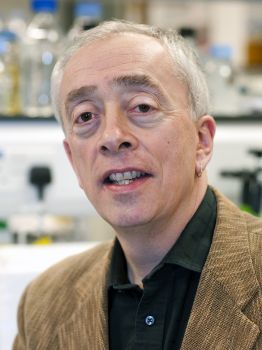
Professor Laurence Pearl
Cancer Research UK Senior Science Information Manager, Dr. Julie Sharp, said "Cancer Research UK scientists have helped to develop and test a number of kinase inhibitors. Having a better understanding of how these drugs work means that researchers can now try and fine tune their use to make them even more effective and improve survival for cancer patients."
Dr Michael Dunn, Head of Molecular and Physiological Sciences at the Wellcome Trust, said that this latest discovery has demonstrated the importance of using biology in the quest to understand how cancer medications work. He added that this "very surprising and interesting result" may well lead to more effective therapies in the future.
Written by Christian Nordqvist
Copyright: Medical News Today
Not to be reproduced without permission of Medical News Today
Sigrun Polier, Rahul S Samant, Paul A Clarke, Paul Workman, Chrisostomos Prodromou & Laurence H Pearl
Nature Chemical Biology (2013) doi:10.1038/nchembio.1212. Published online 17 March 2013
MLA
18 Jun. 2013. <http://www.medicalnewstoday.com/articles/257781.php>
APA
http://www.medicalnewstoday.com/articles/257781.php.
Please note: If no author information is provided, the source is cited instead.
Visitor Opinions (latest shown first)
Move forward carefully
posted by Bill Prentice on 21 Mar 2013 at 11:26 amAs a recent patient taking the tyrosine kinase inhibitor vandetanib (Caprelsa, I think that the industry needs to better understand the effects of these drugs on the human body. While they show positive results in keeping people alive longer, one must consider quality of life as well. I was on 1/2 dose of vandetanib for six months to treat my metasticized Medullary Thyroid Cancer (MTC). While my cancer stabilized under this treatment, my life got increasingly worse to the point where I could no longer function. I cannot imagine what life would be likewith "high doses" of this particular drug. I came off the drug three months ago and just now returned to work. My MTC is a very slow growing cancer, but for now I will continue with more traditional treatments.
High doses of kinase inhibitors
posted by Greg Pawelski on 19 Mar 2013 at 1:38 pmAccording to laboratory oncologist Dr. Larry M. Weisenthal, high dose pulse Kinase inhibitors can be effective for central nervous system (CNS) disease, so long as resistance has not developed.
Laboratories like Rational Therapeutics and Weisenthal Cancer Group have been testing erlotinib (Tarceva), lapatinib (Tykerb), sorafenib (Nexavar) and vemurafenib (Zelboraf) - the 'nib' drugs, along with about eight other kinase inhibitors, in actual human tumor primary culture micro-spheroids (microclusters), in various cancers.
This is exactly the area they are interested in. Specifically re-examine the role of all of these compounds in a wide variety of disease. They have often recommend higher dose, pulse/intermittent therapy, in combination with other agents. In addition, they have been successfully increasing the dose of erlotinib (Tarceva) to recapture patients.
These drugs are not identical, however. Some work in some tumors, while others do not -- yet in other tumors, the drugs which didn't work do work and vice versa. You'd think that if they all had the identical mechanism of action that they'd all work or they'd all not work; but that's not the way it goes.
It may have something to do with entry into the cell; efflux out of the cells; inactivation, or whatever. It does show that there's much more to the action of a drug than simply the presence of a "target" molecule.
High doses of kinase inhibitors
posted by Greg Pawelski on 19 Mar 2013 at 8:24 amAccording to laboratory oncologist Dr. Larry M. Weisenthal, high dose pulse Kinase inhibitors can be effective for central nervous system (CNS) disease, so long as resistance has not developed. His Weisenthal Cancer Group has been testing erlotinib, lapatinib, sorafenib and vemurafenib, along with about eight other kinase inhibitors, in actual human tumor primary culture micro-spheroids (microclusters), in various cancers. He has often recommend higher dose, pulse/intermittent therapy, in combination with other agents. These drugs are not identical, however. Some work in some tumors, while others do not -- yet in other tumors, the drugs which didn't work do work and vice versa. You'd think that if they all had the identical mechanism of action that they'd all work or they'd all not work; but that's not the way it goes. It may have something to do with entry into the cell; efflux out of the cells; inactivation, or whatever. It does show that there's much more to the action of a drug than simply the presence of a "target" molecule.
Add Your Opinion On This Article
'Kinase Inhibitors Could Keep Cancer Patients Alive For Much Longer'Please note that we publish your name, but we do not publish your email address. It is only used to let you know when your message is published. We do not use it for any other purpose. Please see our privacy policy for more information.
If you write about specific medications or operations, please do not name health care professionals by name.
All opinions are moderated before being included (to stop spam)
Contact Our News Editors
For any corrections of factual information, or to contact the editors please use our feedback form.
![]()
Please send any medical news or health news press releases to:
Note: Any medical information published on this website is not intended as a substitute for informed medical advice and you should not take any action before consulting with a health care professional. For more information, please read our terms and conditions.