
Key takeaways
- Cellulite is a common, natural condition characterized by dimpled or lumpy skin on areas such as the thighs and buttocks.
- Cellulite occurs when fat pushes through connective tissue under the skin. This can happen regardless of a person’s age, weight, or gender.
- Risk factors for cellulite development include age, hormonal changes, a sedentary lifestyle, and poor nutrition.
Cellulite is a harmless, natural occurrence. Some people may dislike the appearance of cellulite, and many treatments claim to reduce its visibility.
In this article, we detail the causes, classifications, and effective treatments of cellulite.
A note about sex and gender
Sex and gender exist on spectrums. This article will use the terms “male,” “female,” or both to refer to sex assigned at birth. Learn more.
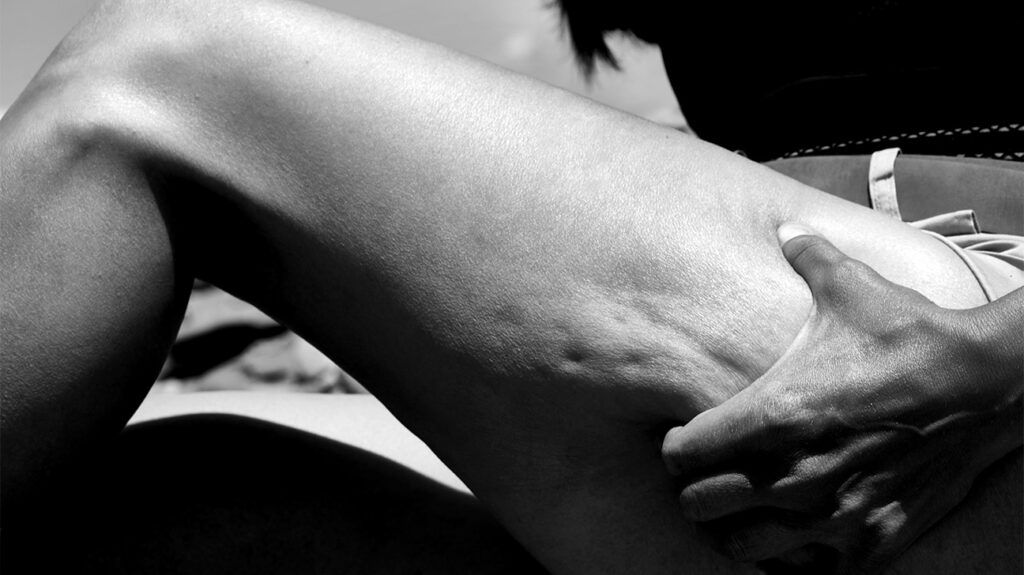
Cellulite is a term for the formation of lumps and dimples in the skin.
Cellulite can affect all sexes, but it is more common in females due to the different distributions of fat, muscle, and connective tissue.
There are several methods of grading cellulite appearance. Each of these methods has slightly different classifications.
Nürnberger-Müller classification
This is a four-point grading scale that involves visual and physical assessment of cellulite areas.
- Grade 0: A person’s skin is smooth, and no cellulite is present.
- Grade 1: A person’s skin is smooth at rest, but shows dimpling when an area is pinched together.
- Grade 2: A person’s skin is smooth when lying, but cellulite is visible when standing.
- Grade 3: A person has visible cellulite lying down as well as standing.
Cellulite severity scale (CSS)
The CSS builds on the Nürnberger-Müller classification and ranks individual symptom presentations.
| Symptom | Assessment |
|---|---|
| Number of depressions | 0: none 1: 1 to 4 2: 5 to 9 3: 10 or more |
| Depression depth | 0: no 1: superficial 2: medium-depth 3: deep |
| Appearance | 0: no cellulite 1: orange peel apperance 2: cottage cheese appearance 3: mattress-like appearance |
| Skin losseness (laxity) | 0: no looseness 1: slight draped appearance 2: moderate draped appearance 3: severe draped appearance |
| Nürnberger-Müller classification | Grades 0 to 3 |
Clinician Reported Photonumeric Cellulite Severity Scale (CR-PCSS)
The Clinician-Reported Photonumeric Cellulite Severity Scale (CR-PCSS) and the Patient-Reported Photonumeric Cellulite Severity Scale (PR-PCSS) are simplified grading structures that enable patient self-reporting.
These grades relate to cellulitis on the buttocks and thighs and utilize a five-point grading system, with each stage corresponding to a specific photograph and accompanying description. The grades are:
- 0: None
- 1: Almost none
- 2: Mild
- 3: Moderate
- 4: Severe
Cellulite occurs due to an interaction between the connective tissue below the surface of the skin and the layer of fat that is just below it. However, doctors do not fully understand what causes this to happen.
In women, the fat cells and connective tissue in this layer are arranged vertically. If the fat cells protrude into the layer of skin, this gives the appearance of cellulite. In men, the tissue has a criss-cross structure, which may explain why they are less likely to have cellulite than women.
Other risk factors for he development of cellulite include:
- hormonal changes, especially changes in estrogen levels
- age
- sedentary lifestyle
- poor diet
Several therapies have been proposed for reducing cellulite, but none have been confirmed by scientific research. it is critical to work with a healthcare professional to fully assess the benfits and risks of different treatment options.
The American Academy of Dermatology (AAD) has reviewed several techniques that may be effective in reducing the appearance of cellulite by breaking up the bands of connective tissue beneath the skin’s surface.
- Acoustic wave therapy: This uses a hand-held device to transmit sound waves. It may work, but it can take several sessions.
- Laser treatment: Laser treatments may improve the appearance of cellulite for a year or more. It involves inserting a very small laser probe under the skin.
- Subcision: This involves a trained healthcare professional putting a needle under the skin to break up the connective tissue bands. Results can last two years or more, according to the AAD.
- Vacuum-assisted precise tissue release: This cuts connective tissue bands, allowing the tissue underneath moves up to fill the space under the skin, removing the appearance of cellulite. This may last for 3 years, but data on its success is limited.
- Weight loss: Carrying excess weight can make cellulite more visible. Reaching and maintaining a moderate weight can help minimize cellulite appearance.
- Exercise: Increasing muscle mass in the affected areas can reduce the appearance of cellulite.
The following treatments are available, but there is little research to suggest they are effective.
- Carboxytherapy: This involves inserting carbon dioxide gas under the skin. Side effects include bruising and discomfort after the procedure, but some cellulite might disappear.
- Endermologie: Endermologie involves a deep massage with a vacuum-like device that lifts the skin. The United States (U.S.) Food and Drug Administration (FDA) has approved it as safe, but there is little evidence that it works.
- Ionithermie cellulite reduction treatment: This treatment involves covering the affected area with a special mud or clay, then wrapping it in plastic before applying an electric current. It is not proven to be effective.
- Radiotherapy: This therapy aims to reduce cellulite by heating it, but any results are short-term.
Medications and creams
Some medications and creams have been proposed because they act on fatty tissues.
Some topical cellulite treatments contain caffeine as an active ingredient. This can dehydrate cells, making them less visible, although daily application is required.
Other treatments use retinol to reduce the appearance of cellulite by thickening the skin. At least 6 months’ use is needed to see results. It is important to try a patch test first, because some people have experienced adverse effects, such as a racing heart.
Cellulite is a natural, harmless occurrence. It happens when disruptions in connective tissues, just below the skin’s surface, allow the lower layer of fat to push through toward the skin. This can result in dimpled, bumpy patches of skin.
While cellulitis is harmless, many people may dislike its visual appearance. In these instances, many potential treatment options are available, including acoustic wave therapy, laser treatments, and topical products.
It is essential to speak with a healthcare professional before engaging with any new treatment option.