
Thyroid nodules are lumps that can develop on the thyroid gland. They may be solid and look dark on an ultrasound scan. Most are benign, but there is a low risk of thyroid cancer.
The thyroid is a small gland in the front of the neck that produces hormones to regulate the body’s metabolism, which describes the chemical reactions that provide the body with energy. Nodules can develop on this gland due to the growth of thyroid tissue or a cyst, which is a sac-like structure filled with fluid.
In this article, we explore what hypoechoic nodules are and whether there is a risk of cancer. We also discuss the causes and what happens after a doctor detects a hypoechoic nodule.
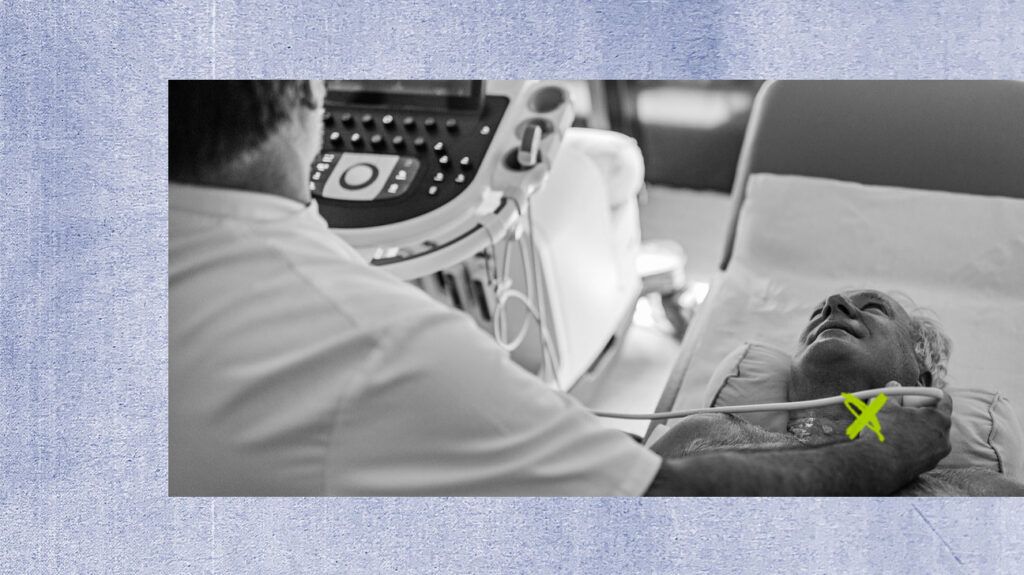
If a thyroid nodule is big enough, it can cause a lump or swelling in the neck that a person might be able to feel. A doctor may also discover thyroid nodules during a routine examination or an imaging test of an individual’s head and neck.
Doctors typically evaluate thyroid nodules using an ultrasound examination, which they may also refer to as a sonogram.
Thyroid nodules have specific characteristics that allow a doctor to assess the potential risk of thyroid cancer. For example, cystic or fluid-filled thyroid nodules are often benign, which means they are noncancerous.
The
Most thyroid nodules are benign. According to the American Thyroid Association (ATA), about 5% of thyroid nodules are cancerous.
People need to note that other characteristics, such as size, may also indicate the potential risk of a nodule developing into thyroid cancer. Doctors will recommend further testing if necessary.
If a doctor suspects that a nodule is cancerous, they may perform a fine needle biopsy to take a small sample of cells for further analysis.
Cancer resources
To discover more evidence-based information and resources for cancer, visit our dedicated hub.
According to the ATA, around 50% of people have a detectable thyroid nodule by the age of 60 years. However, many individuals do not know that they have a thyroid nodule.
Doctors are not exactly sure what causes most thyroid nodules. However, certain conditions, including Hashimoto’s thyroiditis and iodine deficiency, can increase the risk of developing thyroid nodules.
Hashimoto’s thyroiditis is an underlying autoimmune condition and the most common cause of hypothyroidism (underactive thyroid).
Iodine deficiency can lead to an enlarged thyroid gland or goiter. However, it is very uncommon in high income countries such as the United States.
If a doctor detects a hypoechoic thyroid nodule on an ultrasound examination, they may recommend that the person undergo additional testing or surgery. We discuss these options below.
Blood testing
A doctor may order blood tests to check if the thyroid is functioning properly. Blood tests can measure the levels of thyroid-stimulating hormone and thyroxine, which can indicate whether a person has hypothyroidism or hyperthyroidism (overactive thyroid).
Fine-needle biopsy
A fine needle biopsy is a quick procedure that doctors can often perform in their office or clinic. It involves inserting a fine needle through the skin of the person’s neck and into the nodule to take a small sample of tissue. The doctor may use ultrasound scanning to help guide the needle.
A pathologist will then examine the tissue sample under a microscope to check for the presence of cancerous cells.
Nuclear thyroid scan
Less commonly, a doctor may recommend a nuclear thyroid scan. This test can help evaluate nodules that cause hyperthyroidism.
Healthcare professionals may recommend this option less frequently than in the past. This is because ultrasound and biopsy results are the most accurate way to evaluate thyroid nodules in many scenarios.
Surgery
If a doctor suspects that a thyroid nodule is cancerous, they will usually recommend a thyroidectomy. This involves a surgical procedure to remove part or all of the thyroid gland. Following a total thyroidectomy, people
If thyroid cancer is small and confined to the thyroid gland, then surgery may be enough to cure the cancer without further treatment. A doctor may recommend watchful waiting, meaning they will monitor the condition for changes that indicate treatment is necessary.
However, if the cancer spreads to the lymph nodes or other parts of the body, a person may require
Doctors may also recommend surgery for people with noncancerous thyroid nodules that are causing symptoms such as vocal changes and swallowing or breathing difficulties.
Thyroid nodules develop on the thyroid gland. They are relatively common in older adults, but most are benign.
Doctors typically evaluate thyroid nodules using ultrasound scans. Hypoechoic thyroid nodules appear dark relative to the surrounding tissue on ultrasound images. These types of nodules are usually solid rather than fluid-filled lesions.
If a doctor suspects that a thyroid nodule may be cancerous, they will recommend additional testing, such as blood tests and biopsies.
The main treatment for cancerous nodules is surgical removal of part or all of the thyroid gland. A doctor may also recommend the removal of noncancerous nodules that are causing problems.