Key takeaways
- Tremfya is a brand-name drug used to treat moderate to severe plaque psoriasis, active psoriatic arthritis, moderate to severely active ulcerative colitis (UC), and Crohn’s disease.
- Tremfya is given by subcutaneous injection with a prefilled syringe, pen, or One-Press injector. For UC and Crohn’s disease, starting doses are given as intravenous (IV) infusions or subcutaneous injections.
- Dosages of Tremfya for plaque psoriasis and psoriatic arthritis involve two starter doses of 100 milligrams (mg), followed by a maintenance dose of one 100-mg injection every 8 weeks.
Tremfya (guselkumab) is a brand-name drug prescribed for plaque psoriasis and other inflammatory conditions in adults. Tremfya comes as an injection. Tremfya’s dosage can vary depending on the condition the drug is used to treat.
Specifically, the Food and Drug Administration (FDA) has approved Tremfya to treat the following conditions:
- moderate to severe plaque psoriasis in adults and children ages 6 years and older who weigh at least 40 kilograms (88 pounds)
- active psoriatic arthritis in adults and children ages 6 years and older who weigh at least 40 kilograms (88 pounds)
- moderately to severely active UC
- moderately to severely active Crohn’s disease
“Active” means that the condition is currently causing symptoms.
Tremfya is usually given as a subcutaneous injection. However, it’s administered as an intravenous (IV) infusion at the beginning of treatment for ulcerative colitis and Crohn’s disease.
The active ingredient in Tremfya is guselkumab, which belongs to a class of drugs known as interleukin-23 (IL-23) blockers. Tremfya is a biologic drug. It is not available in a biosimilar version.
This article describes the dosages of Tremfya, as well as its forms, strengths, and how to use it.
Here you’ll find information on typical dosages for the conditions Tremfya treats.
Tremfya forms
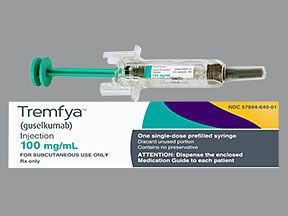
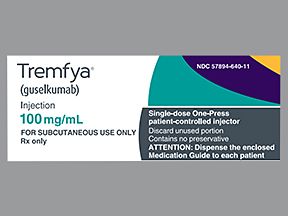
Tremfya comes in the following forms, which all contain a single dose of the drug in a liquid solution:
- prefilled syringe
- prefilled One-Press injector
- prefilled pen
- vial
The syringe, One-Press injector, and pen are used to provide a subcutaneous injection. This is an injection under the skin. The One-Press injector contains a hidden needle, so it may be a good option if you aren’t comfortable with needles. The injector may also be easier to use than a syringe. Your doctor can discuss with you the differences between the forms and which one may be right for you.
The vial contains a solution used to provide an IV infusion. An IV infusion is an injection into a vein that’s given over time. If you’re receiving Tremfya for ulcerative colitis or Crohn’s disease, you’ll have IV infusions at the start of treatment. Then your doctor will switch you to subcutaneous injections.
Tremfya strengths
The forms of Tremfya for subcutaneous injection contain a single dose of the drug in the following strengths. The strengths are given in milligrams per milliliter (mg/mL).
| Tremfya form | Strength(s) |
|---|---|
| prefilled syringe | 100 mg/mL and 200 mg/2 mL |
| prefilled Tremfya Pen | 100 mg/ml and 200 mg/2 mL |
| One-Press (patient-controlled) injector | 100 mg/mL |
For IV infusion, the single-dose vial comes in one strength: 200 mg/20 mL.
Typical dosages
The following information describes the standard Tremfya dosages.
Dosage for plaque psoriasis and psoriatic arthritis
The dosage of Tremfya for moderate to severe plaque psoriasis and active psoriatic arthritis is the same.
You’ll first receive two starter doses. The first dose will be a 100-mg injection. After 4 weeks, you’ll receive another 100-mg injection.
The starter doses are similar to loading doses. They’re meant to quickly raise the level of Tremfya in your body so that the drug can start working.
After the first two doses, your dosing schedule will be one 100-mg injection of Tremfya every 8 weeks. These are known as maintenance doses.
Note: For psoriatic arthritis, you may use Tremfya with other medications called disease-modifying antirheumatic drugs (DMARDs).
Dosage for ulcerative colitis
For treating ulcerative colitis (UC), you’ll receive your starting doses as IV infusions. This part of the treatment is known as induction. It’s called this because it’s meant to induce remission. With remission, you have no symptoms or few symptoms of UC.
For induction, a healthcare professional will give you a 200-mg dose by IV infusion over the course of at least 1 hour. After your initial infusion, you will receive a second 200-mg infusion 4 weeks later, then a third 200-mg infusion after another 4 weeks (8 weeks after the initial Tremfya infusion).
Induction for UC can also be performed with an initial subcutaneous injection of 400 mg of Tremfya, followed by subsequent 400-mg injections under the skin 4 weeks and 8 weeks later.
After induction, you’ll switch over to maintenance treatment. The purpose of this phase of treatment is to keep UC in remission. For maintenance, you’ll receive subcutaneous injections of Tremfya. Your doctor will recommend one of the following dosages:
- a 100-mg injection at Week 16 (8 weeks after your final IV infusion), followed by a 100-mg dose every 8 weeks thereafter, or
- a 200-mg injection at Week 12 (4 weeks after your final IV infusion), followed by a 200-mg injection every 4 weeks thereafter
Dosage for Crohn’s disease
For the induction phase of treatment for Crohn’s disease, you may receive your doses of Tremfya by IV infusion or by subcutaneous injection.
If given via infusions, you will receive an initial IV infusion of 200 mg given over a period of at least 1 hour, followed by another 200-mg infusion at Week 4 and a third 200-mg infusion at Week 8.
If given via subcutaneous injections, you will receive an initial Tremfya dose of 400 mg (given as two consecutive 200-mg injections), followed by another 400-mg dose at Week 4 and a third 400-mg dose at Week 8.
During the subsequent maintenance phase of treatment, the recommended dosages of Tremfya are:
- a 100-mg subcutaneous injection at Week 16, and every 8 weeks thereafter, or
- a 200-mg subcutaneous injection at Week 12, and every 4 weeks thereafter
Long-term use
Tremfya is meant to be used as a long-term treatment. If you and your doctor determine that Tremfya is safe and effective for you, you’ll likely receive it long term.
For all indications, your doctor will prescribe the lowest effective long-term Tremfya dosage to manage your condition.
Here you’ll find information on how Tremfya is given.
Tremfya by subcutaneous injection
For your first dose of Tremfya, your doctor will show you or your caregiver how to inject Tremfya subcutaneously. After that, you or your caregiver will be able to inject the medication. When you do, be sure to follow your doctor’s instructions carefully.
You can also find step-by-step instructions on how to administer Tremfya using a syringe, pen, or a One-Press injector under “Instructions for use” in Tremfya’s prescribing information. In addition, the manufacturer’s website has how-to videos for injecting Tremfya that you may find useful.
The manufacturer recommends injecting Tremfya into the skin on the front of your thigh. But you can also inject into your lower abdomen (except within 2 inches of your belly button). Or the drug can be injected into the back of your upper arm, but only if a caregiver is giving the injection.
Before injecting
Before giving yourself a dose of Tremfya:
- Take the medication out of the refrigerator and let it sit at room temperature, that is 68°F to 77°F (20°C to 25°C) for at least 30 minutes.
- Always check the solution. It should be clear or slightly yellow, and it may have small particles in it. If it’s cloudy, discolored, or contains large particles, discard the dose and use a new one.
- Only use an injection device once. The prefilled syringe, pen, and One-Press injector are single-use only. This means that they hold one dose and should be discarded after one use. Do not reuse a syringe, pen, or injector.
Tremfya by IV infusion
For the first three doses of Tremfya for ulcerative colitis (and possibly for Crohn’s disease), a healthcare professional will prepare and give you the drug by IV infusion in a clinic, infusion center, or other medical setting. Your doctor will let you know what to expect with the infusions.
The infusions take at least 1 hour. However, you’ll want to allow more time for your infusion appointment, including travel time to the location. Your doctor can let you know how much time the appointment will take.
If you forget to take a dose of Tremfya, inject it as soon as you remember. Take your next dose at the regularly scheduled time. Don’t reset your dosing schedule to make up for the missed dose. If you aren’t sure what to do or have a question, call your doctor.
If you miss an appointment for an IV infusion, call your doctor’s office to reschedule right away.
To help make sure you don’t miss a dose, try using a medication reminder such as a reminder app on your phone.
Do not use more Tremfya than your doctor prescribes, as this can lead to harmful effects.
What to do in case you use too much Tremfya
Call your doctor right away if you think you’ve injected too much Tremfya. You can also call 800-222-1222 to reach America’s Poison Centers or use its online resource. But if you have severe symptoms, immediately call 911 (or your local emergency number) or go to the nearest emergency room.
Tremfya is a biologic drug administered via injection, with specific dosages and methods (subcutaneous or intravenous) varying based on the condition being treated.
The initial doses of Tremfya, often called loading or induction doses, are crucial for rapidly elevating drug levels in the body to initiate treatment effectively, especially for conditions like ulcerative colitis and Crohn’s disease.
Patients or caregivers can administer subcutaneous Tremfya injections at home after proper training, following a long-term maintenance dosing schedule typically involving injections every 8 weeks.
This is a summary article for general educational purposes. For more details about Tremfya dosage and dosing schedules, see the drug’s prescribing information or talk with your doctor or pharmacist.
Disclaimer: While Medical News Today strives for factual, comprehensive, and current information, this article is not a substitute for a licensed healthcare professional’s expertise. Always consult a doctor before taking or discontinuing any medication. Drug information is subject to change and may not cover all uses, directions, precautions, warnings, interactions, reactions, or adverse effects. The lack of a warning does not guarantee a drug’s safety, effectiveness, or appropriateness for all patients or specific uses. Learn more about our approach to content integrity.