Politics, lifestyles, beliefs and thoughts were dominated by the Roman Catholic Church. People were Christians and believed in the Christian God. Most of them were also superstitious. It was mainly an authoritarian society, you had to believe what you were told, and if you ever questioned it you could be risking your life.
Towards the end of the tenth century, around 1066, things began to change. The University of Oxford was born (1167), as was the University of Paris (1110). As the monarchs became owners of more territory, their wealth grew, and their courts became centers of culture. Towns began to form, and with them many public health problems. Trade grew rapidly after 1100.
When the Mongols destroyed Baghdad, fleeing scholars managed to take documents and books with them to the west.
Medical stagnation in the Middle Ages in Europe
Much medical knowledge from the Roman and Greek civilizations was lost, consequently the quality of medical practitioners was poor. The Catholic Church did not allow corpses to be dissected; people were encouraged to pray and fear the consequences of not doing as they were told, or thinking differently from Church teachings. It was not an environment conducive to creativity.
Friction developed between the Church and medical practitioners who used incantations as well as Greek, Roman and Islamic methods. Throughout the great civilizations that had preceded the Middle Ages, spells and incantations had persisted, and were used together with herbal and other remedies. The Church insisted that these magical rituals be replaced with Christian prayers and devotions.
Research, development, and observation gave way to an authoritarian system which undermined scientific thinking. There was no money for public health systems. Fiefdoms were at war with each other most of the time.
The authoritarian Church made people believe blindly in what Galen had written. The Church also encouraged people to turn to their saints when seeking treatment and cures for diseases and ailments.
Many people ended up thinking that illness was a punishment from God, and saw no point in trying to find cures. They were taught that repentance for their sins might save them. The practice of penance was born, as well as pilgrimages as a way of finding a cure for illnesses.Some devout Christian felt that medicine was not a profession a faithful person should go into - if God punished with diseases, might not fighting disease be a move against God? God sent illnesses and cures depending on his will, they believed.
Interpretation of Church teachings varied enormously throughout Western Europe. Some monks, such as the Benedictines, did care for the sick and saw this as a Christian duty, and devoted their lives to that.
Some Christians did come into contact with eminent doctors. During the Crusades, many Christians travelled to the Middle East, and learnt about scientific medicine.During the 12th century, many medical books and documents were translated from Arabic. Islamic scholars had translated most of the Greek and Roman texts.
Avicenna's The Canon of Medicine, which included details on Greek, Indian and Muslim medicine was translated and became essential reading throughout Western European centers of learning for several centuries. Several other major texts which originated from Hippocrates, Galen, and others were also translated.
Medieval medicine and the theory of Humors
Humorism was a theory put forward by the ancient Egyptians, and then formally reviewed and adopted by Greeks scholars and physicians; it was then taken up by Roman, Medieval Islamic and European doctors, and prevailed right up until the 19th century. The theory, which lasted two thousand years, is now discredited.
Believers in humorism said that human health is driven by four different bodily fluids - humors - which influence our health. They have to be in perfect balance. This theory is said to have come from Hippocrates and scholars from his school. A humor was also known as a cambium (plural: cambia/cambiums).
The four humors were (with their links to seasons, organs, temper, and element):
- (Humor) Black bile
Linked to (temper) melancholy, (organ) the spleen, (nature) cold dry, and (element) earth - (Humor) Yellow bile
Linked to (temper) phlegmatic, (organ) the lungs, (nature) cold wet, and (element( water - (Humor) Phlegm
Linked to (temper) sanguine, (organ) the head, (nature) warm wet, and (element) air - (Humor) Blood
Linked to (temper) choleric, (organ) gallbladder, (nature) warm dry, and (element) fire
Some of the "temper" terms are used today when we talk about people's personalities: sanguine, choleric, melancholic, and phlegmatic.
All diseases and disorders are caused by too much or not enough of one of these humors. An imbalance of humors could be caused by inhaling or absorbing vapors. Medical establishments believed that levels of these humors would fluctuate in the body, depending on what we ate, drank, inhaled, and what we had been doing.
Humor imbalances not would only cause physical problems, but changes in the person's personality as well.
Lung problems were caused by too much phlegm in the body - the body's natural reaction was to cough it up. Restoring the right balance required blood-letting (using leeches), following a special diet, and taking specific remedies.During Medieval times, most of the world believed in the four humors theory. Monasteries, which led medical research and practice in Medieval Europe had extensive herb gardens for the production of remedies - certain herbs were ascribed to a humor.
The monks believed in the Christian Doctrine of Signature which said that God would provide some kind of relief for every disease, and that each substance had a signature which indicated how effective it might be. For example, some seeds that looked like miniature skulls, such as the skullcap, were used to treat headache.
The most famous medieval book on herbs is probably the Read Book of Hergest (1400) which was written in Welsh around 1390.
European Medieval hospitals
Hospitals had a slightly different meaning during the Middle Ages, compared to what we understand today. They were more like hospices, or homes for the aged and needy. Not only the sick found their place in hospitals, but also paupers, blind people, pilgrims, travelers, orphans, people with mental illness, and other destitute individuals. For those in desperate need, the Christian thing to do was provide hospitality, i.e. food and shelter, and medical care if necessary.
During the Early Middle Ages, hospitals were not used much for the treatment of sick people, unless they had particular spiritual needs or nowhere to live.
Monasteries throughout Europe had several hospitals, which provided medical care and spiritual guidance.
The Hotel-Dieu, founded in Lyons in 542 AD by Childebert I, king of the Franks, is the oldest hospital in France. The 28th Bishop of Paris founded the Hotel-Dieu of Paris in 652 AD. Santa Maria Della Scala, Siena, built in 898 AD is the oldest hospital in Italy.
The oldest hospital in England was built in 937 AD by the Saxons. After the Norman Conquest (Battle of Hasting, 1066), many more were built. A well known hospital in London today, St. Bartholomew's of London, was build in 1123. A hospital was called a hospitium or hospice for pilgrims. As time went by, the hospitium developed and became more like what we today understand as a hospital, with monks providing the expert medical care and lay people helping them.
During the Crusade in the 12th century, the building of hospitals became more of a priority. An enormous number of hospitals were founded during the 13th century, especially in Italy; over a dozen were built in Milan alone. By the end of the 14th century Florence had over 30 hospitals, some of them were architectural works of art.
The plagues of the 14th century triggered the construction of even more hospitals.
According to Benjamin Lee Gordon, who wrote the book "Medieval and Renaissance Medicine" in 1959, the hospital as we know it today was invented by the French, but was originally set up to help plague victims, to separate lepers from the community, and later on to provide shelter for pilgrims.
What was Medieval surgery like?
There were some advances in surgery during the Middle Ages. Barbers-come-surgeons learnt useful skills tending to wounded soldiers in the battlefield. Monks and scientists also discovered some valuable plants with powerful anesthetic and antiseptic qualities.
This long period of stagnation in medicine had one exception, historians say - "surgery".
Barbers were in charge of surgery in medieval Europe, not doctors. During the Middle Ages there were frequent battles and wars, some of them lasting up to 100 years. The skills of surgeons were much sought after in the battlefield.
Theodoric of Lucca, son of Hugh of Lucca who was appointed surgeon for Bologna in Italy during the 13th century, said of the clever way of dealing with wounds:
"Every day we see new instruments and new methods (to remove arrows) being invented by clever and ingenious surgeons."
Hugh of Lucca noticed that wine was an effective antiseptic; it was useful for washing out wounds and preventing further infection. This observation would have been an empirical one because at that time people had no idea that infections were caused by germs. His observation was heeded by many surgeons who started using wine for treating wounds, but many continued using ointments and/or cauterization. Hugh believed pus was not a healthy sign, something most other surgeons disagreed with. Many saw pus as a good sign of the body ridding itself of toxins in the blood.
The following natural substances were used by medieval surgeons as anesthetics:
- Mandrake roots
- Opium
- Gall of boar
- Hemlock
Medieval surgeons became experts in external surgery (surgery not deep inside the body), and treated eye cataracts, ulcers and various types of wounds. Records show they were even able to surgically remove bladder stones.
Poor hygiene and infection link - unfortunately, nobody knew that lack of hygiene dramatically increases the risk of infection, especially during and after surgery. Many wounds were fatal because of infection caused by poor hygiene.
Trepanning - some patients with neurological disorders, such as epilepsy, would have a hole drilled into their skulls "to let the demons out".
During the Renaissance surgery advanced much faster
From the 1450s onwards, as the Middle Ages gave way to the Renaissance, advances in medical practice accelerated dramatically:
- Girolamo Fracastoro (1478-1553), an Italian doctor, poet, and scholar in geography, astronomy and mathematics, put forward the idea that epidemics may be caused by pathogens from outside the body that may be passed on from human-to-human by direct or indirect contact.
Fracastoro wrote:
""I call fomites (Latin for "tinder") such things as clothes, linen, etc., which although not themselves corrupt, can nevertheless foster the essential seeds of the contagion and thus cause infection."
He also suggested using mercury and "guaiaco" as a cure for syphilis. Guiaiaco is the oil from the Palo Santo tree, a fragrance used in soaps. - Andreas Vesalius (1514 -1564), a Flemish anatomist, physician, was the author of one of the most influential books on human anatomy "De Humani Corporis Fabrica (On the Structure of the Human Body)". He dissected a corpse and made a careful examination, detailing the structure of the human body. Technical and printing development during the Renaissance made it possible for this book to be made, with incredibly detailed illustrations (compared to anything that had been produced before).
- William Harvey (1578 - 1657), an English doctor was the first person to properly describe the systemic circulation and properties of blood, which is pumped around the body by the heart. In 1242 Avicenna had described a rudimentary account, but he had not fully understood the pumping action of the heart and how it was responsible for sending blood to every part of the body.
- Paracelsus (Philippus Aureolus Theophrastus Bombastus von Hohenheim, 1493 - 1541), a German-Swiss doctor, astrologer, alchemist, botanist, and a general occultist (study of the supernatural). He pioneered the use of minerals and chemicals in the body. He believed that illness and health relied on the harmony of man with nature. Rather than seeking soul purification for healing, he proposed that certain chemical and mineral balances in the body were required for health; he added that some illnesses could be treated and cured with chemical remedies. Paracelsus wrote about the treatment and prevention strategies for metalworkers, as well as detailing their occupational hazards.
-
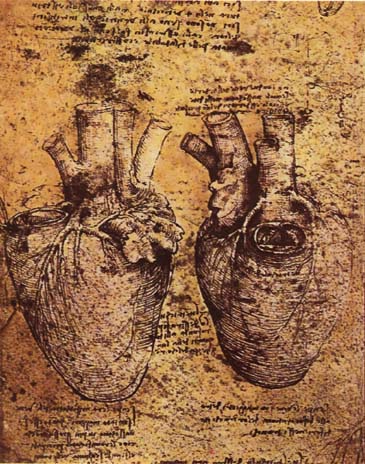
Leonardo Da Vinci's drawings of the heart and
its blood vesselsLeonardo Da Vinci (1452 - 1519), from Italy, considered by many to have been a genius. Da Vinci was a polymath - somebody who was expert in several different fields. Da Vinci was a painter, sculptor, scientist, engineer, mathematician, musician, anatomist, inventor, cartographer, botanist, geologist and writer.
Anatomy - Da Vinci rapidly became an expert in topographic anatomy, and drew several studies of tendons, muscles, bones, and other features of the human body. The Hospital of Santa Maria Nuova, Florence, allowed him to dissect human corpses, as did some other hospitals in Milan and Rome. He worked with doctor Marcantonio della Torre and drew over 200 pages of illustrations with notes about the human anatomy.
The papers were bequeathed to Francesco Melzi on condition that he published them. Melzi found this to be a monumental task, firstly because there were so many of them, and also because Da Vinci's writings were "idiosyncratic". The papers were finally published in France in 1632.Da Vinci not only drew body parts in great detail, he also studied the mechanical functions of bones and how the muscles made them move - he is said to have been one of the first researchers of biomechanics.
- Ambroise Paré (1510 - 1590), from France, viewed by many as one of the fathers of modern forensic pathology and surgery. He was the Royal Surgeon for four French Kings. Paré was incredibly skilled in surgical techniques, and a renowned expert in battlefield medicine, particularly the effective treatment of wounds. Several surgical instruments were invented by Paré.
Paré is famous for the following quote:
"Je le pansai, Dieu le guérit"
(I bandaged him and God healed him)
Paré once treated a group of wounded patients in two ways - cauterization and with boiled elderberry oil. However, he ran out of oil and treated the rest of the second group with turpentine, oil of roses, and egg yolk. When he saw his patients the following day, he noticed that the ones treated with turpentine had recovered, while those who had been administered the boiling oil were still in severe pain. He immediately realized how effective turpentine was in treating wounds, and virtually abandoned cauterization from that moment onwards.
Paré also revived the Greek method of ligature of the arteries during amputation, instead of cauterization. This method significantly improved survival rates. This was seen as a considerable breakthrough in surgical practice, despite it being a serious source of infection. He believed that phantom pains, sometimes experienced by amputees, were to do with something occurring in the brain, and not something mysterious within the amputated limb.

Pandemics and epidemics thrived during the Renaissance
During the Renaissance, Europe starting trading with nations from all over the world. While this was good for wealth and many people's standards of living, it also exposed them to pathogens from faraway lands.
The Black Death, often referred to as The Plague, started off in Asia, and made its way westward, hitting Western and Mediterranean Europe in 1348. Medical historians believe Italian merchants brought it to Europe when they fled the fighting in Crimea.

The Great Plague of London killed over
100,000 people, an example of plague
recurrence in Europe
The Black Death - Over a period of six years about one-third of Europe's population perished; approximately 25 million people. In city suburbs the plague is thought to have killed over two-thirds of residents. Historians say the Mongols catapulted dead bodies over Kaffa's walls (in the Crimea); the aim being to infect enemy soldiers. This is probably the first example of biological warfare. Many believe that this action started off the spread of infection into Europe.
The plague did not just come and go away for ever. It kept coming back and caused devastation in several areas right up to the 17th century.
Infections and the New World - deadly influenza, measles and smallpox were not viruses that circulated in the Americas before the Spanish explorers came. Native Americans had no immunity against such diseases.
When Christopher and his men arrived in the Caribbean in 1492, the area became ridden with deadly epidemics. Within 20 years, the population of Hispaniola, an island, dropped from 250,000 to less than 6,000 due to smallpox infections; within five decades the indigenous population of the island was estimated to have fallen to 500.
The smallpox virus then made its way to the mainland, where it decimated the Aztec population. Millions of people died from infections in South and Central America during the first hundred years after Columbus' arrival. Historians say that over half of Mexico's indigenous population had died by 1650.Personal hygiene - during the Renaissance, bathing remained popular. It was not until after this period that Europeans viewed water as a carrier of disease and the Catholic Church started wondering about the immorality of public bathing. The Church eventually banned public bathing in an attempt to stem the spread of syphilis (which continued to spread).
Diagnosis and treatment of diseases during the Renaissance
Methods of diagnosis during the early Renaissance period were not very different from what occurred during the Middle Ages. Physicians had no idea how to cure infectious disease. When faced with the plague or syphilis they did not really know what to do.
Ineffective desperate attempts at treating diseases also included superstitious rites and magic. Even the King, Charles II, was asked to help out by touching sick people in an attempt to cure them of scrofula (The King's Evil). Scrofula was most likely a type of tuberculosis.
Quinine was discovered in the New World and was used to treat malaria.
First example of Vaccination
Edward Anthony Jenner (1749-1823) was an English doctor and scientists. He is known as the pioneer of vaccinations, having created the smallpox vaccine. Medical historians call him the "Father of Immunology". His works are believed to have eventually saved more lives than those of any other person.

Edward Jenner, pioneer of the cowpox vaccine
Jenner noticed that milkmaids tended to be immune to smallpox. He wondered whether the pus in the cowpox blisters protected them from smallpox. Cowpox is similar to smallpox, but much milder.
In 1796, Jenner inserted pus taken from a cowpox pustule into the arm of James Phipps, an eight-year old boy. He then proved that Phipps was immune to smallpox because of the cowpox "vaccine". In 1979 he submitted his study to the Royal Society - he was told his ideas were too radical and further proof was needed.
Jenner was ridiculed by the clergy and some of his peers. The Church said it was disgusting, even ungodly to inoculate a person with substances from sick animals. A magazine published a cartoon with patients sprouting cow's heads from their bodies.
Jenner did not give up and tried the vaccine on other kids, including his 11-month old son. His successful experiments were finally published in 1798. Jenner coined the term "vaccine" from vacca, which in Latin means "cow".
On the next page, we look at modern medicine.