<?php
// include header script for counter
set_include_path($_SERVER["DOCUMENT_ROOT"]);
include "structure/framework/header.php";

//<!-- commented out for new site

Function GenToken() {
	
	// This creates a token value that is passed to results.php to check that someone else isn't framing the results in their own website
    $allkey = date("zY") . "_" . "yH94Rfd3aKL32e";
	
	/* echo "generating token with key [$allkey]<p>"; */

    $token = md5($allkey);

	unset($allkey);
    return $token;
}

//-->
?>
<?php
$glob_pageType = "info";

// ################################
// Meta and page-top template
?>
<!DOCTYPE html>
<html lang="en">
<head>
<meta http-equiv="Content-Type" content="text/html; charset=UTF-8">
<?php
require_once "structure/framework/head/head_top.php";
?>
<title>BMI (Body Mass Index): What Is BMI?</title>
<meta property="og:url" content="<?php echo $canonicalURL; ?>"/>
<meta property="og:title" content="BMI (Body Mass Index): What Is BMI?"/>
<meta name="description" content="Learn all about BMI, how to calculate your BMI and what it means">
<?php
$categoryID = 21;
$subsectionID = 90;
$subpageID = 4;
$articleCategoryURL = "fitness-obesity/";
$usefulLinkQueryString = isset($articleCategoryURL)?"?c=".substr($articleCategoryURL, 0, -1):"";
require_once "structure/framework/head/meta_pages.php";
require_once "structure/framework/main/info/static_info_default_top.php";
// ################################
?>

<!-- start_content -->


<span class="breadcrumb">
<a href="/knowledge-center">knowledge center home</a> &raquo; <a href="/info/obesity/">obesity / weight loss</a> &raquo; BMI</span> <!-- /breadcrumb -->
  
<h1>BMI (Body Mass Index)</h1>

<div class="info_toc">
<ul>
<li><a href="/info/obesity/">What is Obesity?</a></li>
<li><a href="/info/obesity/treatments-for-obesity.php">Treatments For Obesity</a></li>
<li><a href="/info/obesity/how-to-lose-weight.php">How to Lose Weight</a></li>	
<li><a href="/info/obesity/what-is-bmi.php">BMI (Body Mass Index)</a></li>
<li><a href="/info/obesity/bmi-calculators-charts.php">BMI Calculators and Charts</a></li>
<li><a href="/info/obesity/what-is-bmi-2.php">BMI - Health Consequences</a></li>
<li><a href="/info/obesity/bmi-limitations.php">BMI Limitations</a></li>
</ul>
</div>

<a name="bmi"></a>

<p>
<strong>Body mass index (BMI) is a measure of body fat based on your weight in relation to your height, and applies to most adult men and women aged 20 and over. For children aged 2 and over, BMI percentile is the best assessment of body fat.</strong>
</p>	

<p>
BMI does not measure body fat directly. However, research indicates that BMI correlates to direct measures of body fat such as underwater weighing and dual-energy X-ray absorptiometry (DXA), and is considered an inexpensive and easy-to-perform alternative for these.<sup>1,2,4</sup>
</p>	
		
<div class="contents_list">
<p>
<b>Contents of this article:</b>
</p>
<ol>
 <li><a href="#what_is_bmi">What is BMI?</a></li>
 <li><a href="#how_to_calculate_bmi_for_adults">How to calculate BMI for adults</a></li>
 <li><a href="/info/obesity/bmi-calculators-charts.php">BMI calculators and charts</a></li>
 <li><a href="/info/obesity/what-is-bmi-2.php">How is BMI used with children and teens?</a></li>
 <li><a href="/info/obesity/what-is-bmi-2.php#health_consequences_of_overweight_and_obese_adults">Health consequences of overweight and obese adults</a></li>
 <li><a href="/info/obesity/bmi-limitations.php">BMI limitations</a></li>
</ol>
</div>


<p>You will also see introductions at the end of some sections to any recent developments that have been covered by <em>Medical News Today</em>'s news stories. Also, look out for links to information about related conditions.</p>

<div class="quick_facts">

<p>
<span class="quick_facts_title">Fast facts on BMI</span>
</p>

<p>Here are some key points about BMI. More detail and supporting information is in the main article.</p>
<ul>
<li>Body mass index (BMI) is a measure of relative size based on the mass and height of an individual.</li>
<li>The Quetelet Index was devised by Adolphe Quetelet, a Belgian mathematician, astronomer and statistician, in 1832. It was later termed "body mass index" in 1972 by Ancel Keys.</li>
<li>BMI is a simple, inexpensive and noninvasive surrogate measure of body fat.</li>
<li>Factors such as age, sex, ethnicity and muscle mass are not accounted for in BMI.</li>
<li>For adults 20 years and older, BMI is interpreted by using standard weight status categories that are the same for all ages, and for both men and women.</li>
<li>For children and adolescents between 2-20 years old, BMI is interpreted relative to a child's age and sex.</li>
<li>BMI is a reasonable indicator of body fat for both adults and children. </li>
<li>Because BMI does not measure body fat directly, it should not be used as a diagnostic tool.</li>
<li>BMI should be used as a measure to track weight status in populations and as a screening tool to identify potential weight problems in individuals.</li>
<li>Other measures of body fat, such as skinfold thicknesses, bioelectrical impedance, underwater weighing and dual energy X-ray absorption, maybe more accurate than BMI. </li>
</ul>

</div> <!-- /quick_facts -->


<span class="anchor" id="what_is_bmi"></span>
<h2>What is BMI?</h2>

<p>
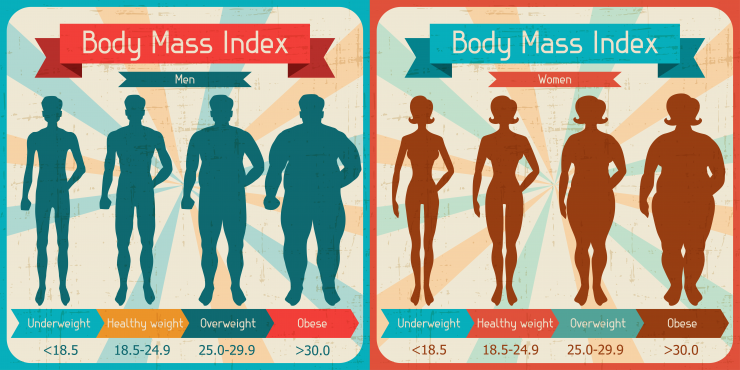
BMI is used as a screening tool to indicate whether a person is underweight, overweight, obese or a healthy weight for their height.
</p>

<p>
If a person's BMI is out of the healthy BMI range, their health risks may increase significantly.<sup>3</sup>
</p>

<p>
BMI values are age-independent and the same for both sexes. However, BMI may not correspond to the same degree of fatness in different populations due to different body proportions.
</p>

<div class="photobox_main" style='max-width:700px;' ><img src="http://www.medicalnewstoday.com/images/articles/292/292304/bmi-for-men-and-women.png" alt="BMI for men and women"><br><em>BMI is interpreted by using standard weight status categories.</em></div>

<p>
The health risks associated with an increasing BMI are continuous, and the interpretation of BMI grading in relation to risk may differ for different populations.<sup>6</sup>
</p>

<p>
There are two ways to check your BMI:
</p>

<ul>
<li>
Use our <a href="#bmi_calculator">BMI calculators</a>
</li>
<li>
Use the <a href="#bmi_chart">BMI chart</a>. First, find your height in the left-hand column. Then, follow it over until you find your weight along the top bar. The number in the center box between the two is your BMI.
</li>
</ul>

<span class="anchor" id="benefits_of_maintaining_a_healthy_weight"></span>
<h2>Benefits of maintaining a healthy weight</h2>

<p>
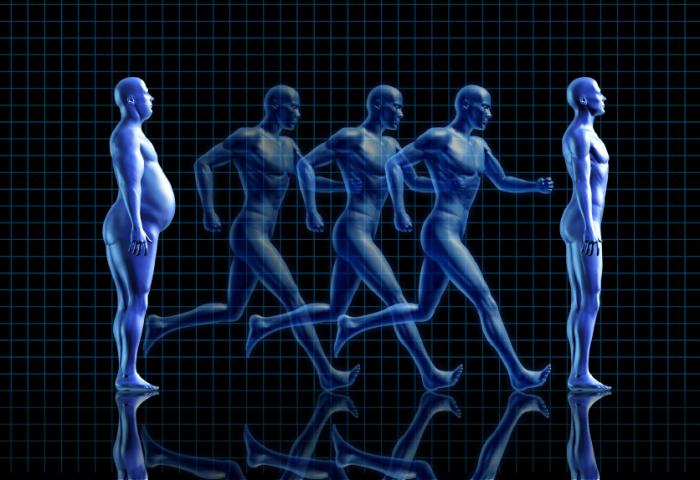
The benefits of maintaining a healthy weight include:<sup>4</sup>
</p>

<div class="photobox_right" style='max-width:350px;' ><img src="http://www.medicalnewstoday.com/images/articles/292/292304/running-from-obese-to-healthy.jpg" alt="running from obese to healthy"><br><em>An exercise plan can help you maintain a healthy BMI.</em></div>

<ul>
<li>Fewer joint and muscle pains</li>
<li>Increased energy and ability to join in more activities</li>
<li>Improved regulation of bodily fluids and blood pressure</li>
<li>Reduced burden on the heart and circulatory system</li>
<li>Improved sleep patterns</li>
<li>Reductions in blood triglycerides, blood glucose, and risk of developing type 2 diabetes</li>
<li>Reduced risk for heart disease and certain cancers.</li>
</ul>	

<p>
Excess weight increases how hard the heart has to work, it also raises blood pressure, blood cholesterol and triglyceride levels and lowers HDL (good) cholesterol levels. Excess weight can make a person more likely to develop diabetes.
</p>

<p>
Lifestyle changes that help you maintain a 3-5% weight loss are likely to result in clinically meaningful improvements in blood glucose, triglycerides and risk of developing type 2 diabetes. Greater weight loss can also help reduce blood pressure and improve blood cholesterol.<sup>4</sup>
</p>

<span class="anchor" id="how_is_bmi_used"></span>
<h2>How is BMI used?</h2>	

<p>
BMI is not accurate enough to be used as a diagnostic tool. However, it is used as a screening tool to identify potential weight problems in adults.
</p>	

<p>
A person may have a high BMI, yet to determine if this excess weight is a health risk, a health care provider would need to complete further assessments such as:<sup>2</sup>
</p>

<ul>
<li>Skinfold thickness measurements</li>
<li>Evaluations of diet</li>
<li>Physical activity</li>
<li>Family history</li>
<li>Other appropriate health screenings.</li>
</ul>

<span class="anchor" id="how_to_calculate_bmi_for_adults"></span>
<h2>How to calculate BMI for adults</h2>

<p>
Belgium Statistician Adolphe Quetelet developed the BMI formula approximately 150 years ago.
</p>

<p>
The calculation of BMI is based on the following formulas:
</p>

<h3>Metric BMI Formula</h3>

<blockquote>
<p>
Weight (kg) / Height (m)<sup>2</sup>
</p>
</blockquote>

<p>
With the metric system, the formula for BMI is weight in kilograms divided by height in meters squared (kg/m2). Since height is commonly measured in centimeters, divide height in centimeters by 100 to obtain height in meters.
</p>

<h3>Imperial BMI Formula</h3>

<blockquote>
<p>
(Weight (lbs.) * 703) / Height (inches)<sup>2</sup>
</p>
</blockquote>

<p>
When using pounds and inches, the formula needs to be altered slightly. Multiply your weight in pounds by 703. Divide that by your height in inches, squared.
</p>

<hr>

<p>
<b>Follow us to the next page</b> to work out your BMI with our BMI calculators and charts.
</p>

<div class="nextpagelink">
<a href="/info/obesity/bmi-calculators-charts.php"><strong>Next Page: </strong>BMI calculators and charts</a>
</div>

<br>
<hr>

<!-- end_content -->

<?php
// ###################################
// Sidebar and Footer Content
// ###################################
include "section_bottom.php";
require_once "structure/framework/main/info/static_info_bottom.php";
// ###################################
?>

</body>

</html>