Key takeaways
- Dosages of Yervoy are based on body weight in kilograms (kg) and typically range from 1 milligram per kg (mg/kg) to 3 mg/kg, depending on the type of cancer being treated.
- A healthcare professional will give you Yervoy as an intravenous (IV) infusion over 30 minutes.
- Treatment length varies by cancer type, but most people receive Yervoy for a maximum of four doses over 12 weeks.
Yervoy (ipilimumab) is a brand-name prescription medication. The Food and Drug Administration (FDA) has approved it for the treatment of certain types of cancer in adults and some children.
This article describes typical dosages and dosing schedules for Yervoy provided by the drug’s manufacturer. Your doctor will prescribe the Yervoy dosage that’s right for you.
Yervoy is approved to treat certain types of cancer. Your dosage can vary depending on which cancer is being treated.
Dosages are based on a person’s body weight in kilograms (kg). For reference, 1 kg is about 2.2 pounds. Your doctor or healthcare professional will calculate your dose of Yervoy based on your weight.
| Type of cancer | Typical dosage |
|---|---|
| melanoma | • 3 milligrams per kg (mg/kg) every 3 weeks for a maximum of four doses • if Yervoy is used in combination with other treatments, the dosage is the same as above but after you complete that dosage, you may receive Yervoy once every 12 weeks for up to four additional doses |
| colorectal cancer | 1 mg/kg every 3 weeks for a maximum of four doses |
| kidney cancer | 1 mg/kg every 3 weeks for a maximum of four doses |
| pleural mesothelioma | 1 mg/kg every 6 weeks for up to 2 years, as long as the drug is safe and effective for you |
| non-small cell lung cancer (NSCLC) | 1 mg/kg every 6 weeks for up to 2 years, as long as the drug is safe and effective for you |
| esophageal cancer | 1 mg/kg every 6 weeks for up to 2 years, as long as the drug is safe and effective for you |
| liver cancer | 3 milligrams per kg (mg/kg) every 3 weeks for a maximum of four doses |
You may also receive Opdivo (nivolumab) with and after completing Yervoy treatment. Your doctor can advise you on the right nivolumab dosing for you.
Children’s dosage
Yervoy is also FDA approved to treat children 12 years and older who have certain types of melanoma or colorectal cancer. The total dosage will depend on the child’s weight in kg. Dosages are the same as for adults.
The length of Yervoy treatment will depend on the type of cancer you have and how well you tolerate the medication. Yervoy is typically prescribed for a maximum of four doses over 12 weeks for melanoma, colorectal cancer, kidney cancer, and liver cancer.
If you’re receiving Yervoy for melanoma in combination with other treatments, you may receive four additional doses up to 1 year as long as the drug is safe and effective for you. Your doctor can advise you on how long you may need Yervoy treatment.
For pleural mesothelioma, NSCLC, or esophageal cancer, Yervoy treatment may last up to 2 years as long as the drug is safe and effective for you. You can talk with your doctor about how long your treatment might last.
A healthcare professional will give you Yervoy as an IV infusion. This is an injection into a vein over a period of time. You’ll receive Yervoy in a hospital, an infusion center, or your doctor’s office.
The length of a Yervoy infusion is typically 30 minutes.
Tip: To help make sure you don’t miss an appointment, try setting a reminder on your phone or putting your schedule on a calendar.
Forms and strengths
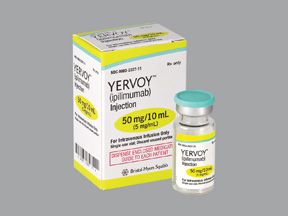
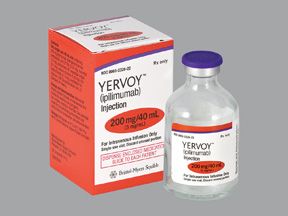
Yervoy comes as a solution in a vial. It comes in one strength: 5 milligrams per milliliter (mg/mL).
The vials come in two sizes:
- 10 mL, which contains 50 mg of Yervoy
- 40 mL, which contains 200 mg of Yervoy
Yervoy is an IV infusion used to treat certain types of cancer. It may be used with other medications, such as Opdivo or chemotherapy.
If you have questions about whether Yervoy is right for you, talk with your doctor.
Disclaimer: While Medical News Today strives for factual, comprehensive, and current drug information, this article is not a substitute for a licensed healthcare professional’s expertise. Always consult a doctor before taking or discontinuing any medication. Drug information is subject to change and may not cover all uses, directions, precautions, warnings, interactions, reactions, or adverse effects. The lack of a warning does not guarantee a drug’s safety, effectiveness, or appropriateness for all patients or specific uses. Learn more about our approach to content integrity.